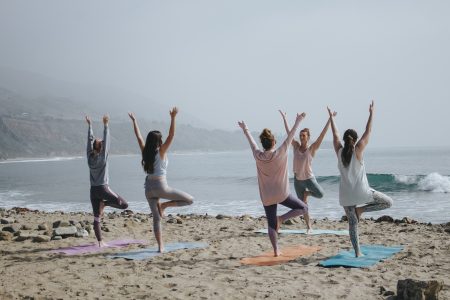
Yoga is no longer some fringe wellness thing hiding in the incense aisle. It is solidly mainstream now, used by millions of Americans for movement, stress relief, meditation, pain management, flexibility, and general sanity maintenance.
Sure, yoga is not as hot as pilates right this second. Pilates has the shiny reformer machines and the cool-girl group chat aura. Yoga is quieter than that. But it is solidly mainstream, and it keeps hanging around like a houseplant that somehow survived three apartments.
The 2026 story is messier than “everyone is doing yoga.” Some people are doing hot yoga. Some are doing chair yoga in their living rooms. Some are typing “puppy yoga near me,” and I am still not sure what to say about this one. Participation is broad, not equal. The industry is huge. The health research is promising, but please, nobody needs another cure-all blog post wearing mala beads.
This guide collects the most useful yoga statistics for 2026, with source notes where the data is strong, dated, uncertain, or commonly misquoted.
Key Yoga Statistics for 2026
Here are the big numbers first. If you only skim one section, make it this one.
| Statistic | What it means | Source |
|---|---|---|
| 16.9% of U.S. adults practiced yoga in 2022. | Yoga is a mainstream adult wellness practice in the United States. | CDC/NCHS |
| 23.3% of women practiced yoga, compared with 10.3% of men. | Women were more than twice as likely as men to practice yoga. | CDC/NCHS |
| 21.3% of adults ages 18-44 practiced yoga. | Yoga participation is highest among younger adults. | CDC/NCHS |
| 8.0% of adults ages 65 and older practiced yoga. | Older adults practice at lower rates, but yoga remains relevant for mobility, balance, and low-impact movement. | CDC/NCHS |
| 80.0% of adult yoga practitioners used yoga to restore overall health. | Most practitioners see yoga as a general wellness practice, not just exercise. | CDC/NCHS |
| 57.4% of adult yoga practitioners included meditation as part of yoga. | For many people, yoga is both physical and meditative. | CDC/NCHS |
| 28.8% of adult yoga practitioners used yoga to treat or manage physical pain. | Pain management is a major reason people practice yoga. | CDC/NCHS |
| Yoga use among U.S. adults rose from 9.5% in 2012 to 14.3% in 2017. | Yoga became significantly more mainstream during the 2010s. | CDC/NCHS |
| 8.4% of U.S. children ages 4-17 used yoga in 2017. | Children’s yoga more than doubled from 2012 to 2017. | CDC/NCHS |
| The global yoga market is estimated at $68.15B to $138.7B in 2026. | Market estimates vary widely depending on whether reports count classes, apps, apparel, retreats, corporate programs, and training. | Fortune Business Insights and Grand View Research |
How Many People Practice Yoga?
The best current U.S. government estimate is that 16.9% of adults age 18 and older practiced yoga in the past 12 months in 2022. That figure comes from the National Health Interview Survey, a nationally representative survey used by the National Center for Health Statistics.
That does not mean every one of those people is sweating through 90-minute power vinyasa classes. The CDC/NCHS question was broader: “During the past 12 months, did you practice yoga as part of a class or on your own?”
That matters. It includes studio yoga, home yoga, online yoga, gentle yoga, meditation-forward yoga, and people who practice privately without ever touching a boutique studio.

Yoga has grown significantly over the past decade. In 2012, 9.5% of U.S. adults used yoga in the past 12 months. By 2017, that figure had risen to 14.3%. In raw numbers, that represented about 22.4 million adult users in 2012 and 35.2 million adult users in 2017.
By 2022, the share had increased again to 16.9% of U.S. adults. That makes yoga one of the most established complementary health and wellness practices in the country.
Is yoga still growing?
Yoga does not look like a brand-new breakout trend anymore. It looks more like one of those practices people wander away from, then come crawling back to when their back hurts, their brain is fried, or January gets too January.
That might actually be the win. Yoga has graduated from hot fitness trend to normal wellness plumbing: studio classes, online classes, YouTube flows, corporate wellness programs, retreats, teacher trainings, yoga therapy, athletic recovery, prenatal classes, senior yoga, meditation apps, and hybrid mind-body workouts.
For beginners looking for affordable options, YogaEarth’s guide to the best yoga classes on YouTube is a useful next step.
What Counts as Yoga in the Data?
Yoga statistics get slippery fast.
Some studies count yoga as a complementary health practice. Some market reports count yoga courses, apps, retreats, apparel, mats, and teacher training. Google Trends counts search interest, not bodies in a class. None of these are the same thing.

For participation data, this article prioritizes CDC/NCHS because it is nationally representative and clearly asks whether adults practiced yoga in the past 12 months. For health claims, it leans on NCCIH because the language is cautious. For market size, it includes commercial research estimates but labels them as estimates.
In plain English: one number cannot tell the whole yoga story. A few good numbers can still save us from nonsense.
Yoga Demographics
Yoga is solidly mainstream now. But it is not evenly sprinkled across America like fairy dust over a Lululemon ad.
The CDC/NCHS data shows the gaps by sex, age, race and Hispanic origin, and family income. Useful, awkward, very human.

Yoga participation by sex
| Group | Percentage who practiced yoga in 2022 |
|---|---|
| Women | 23.3% |
| Men | 10.3% |
Women were more than twice as likely as men to practice yoga in 2022. This pattern is not new. Earlier CDC/NCHS data from 2017 also found that women were more likely than men to use yoga.
That said, men are still an important yoga audience. Plenty of men use yoga for mobility, flexibility, athletic recovery, back pain, stress relief, and breath control. The opportunity is not to slap a skull logo on a yoga mat and call it “broga.” The opportunity is to make yoga feel less culturally narrow and more useful to different bodies, personalities, and goals.
Yoga participation by age
| Age group | Percentage who practiced yoga in 2022 |
|---|---|
| 18-44 | 21.3% |
| 45-64 | 14.1% |
| 65 and older | 8.0% |
Yoga participation decreases with age, but the 65+ number should not be dismissed. Gentle yoga, chair yoga, restorative yoga, balance-focused yoga, and mobility-oriented practices are all relevant for older adults, especially when taught safely and adapted to the student.
Yoga participation by race and Hispanic origin
| Group | Percentage who practiced yoga in 2022 |
|---|---|
| Asian, non-Hispanic adults | 22.5% |
| White, non-Hispanic adults | 19.3% |
| Other and multiple races, non-Hispanic adults | 15.7% |
| Black, non-Hispanic adults | 12.6% |
| Hispanic adults | 10.5% |
These numbers show both yoga’s reach and its accessibility gaps. Yoga is often marketed as universal, but real participation still varies by culture, income, location, price, studio environment, and whether people feel that yoga spaces are genuinely welcoming.
Yoga participation by income
| Family income level | Percentage who practiced yoga in 2022 |
|---|---|
| Less than 200% of the federal poverty level | 10.4% |
| 200% to less than 400% of the federal poverty level | 14.0% |
| 400% of the federal poverty level or more | 23.0% |
Yoga participation rises with income. That likely reflects access to studios, time flexibility, neighborhood availability, transportation, digital subscriptions, private instruction, and comfort entering wellness spaces.
This is one of the most important realities in modern yoga: the practice itself can be simple and low-cost, but the commercial yoga world can still feel expensive and exclusive.
Why People Practice Yoga
Yoga is often discussed as exercise, but CDC/NCHS data shows that many people use it as a broader health and wellness practice.

| Reason or component | Percentage of adult yoga practitioners in 2022 |
|---|---|
| Used yoga to restore overall health | 80.0% |
| Included meditation as part of yoga | 57.4% |
| Used yoga to treat or manage physical pain | 28.8% |
The simplest interpretation: most people do yoga because they want to feel better.
Some want flexibility. Some want stress relief. Some want a stronger body. Some want a calmer mind. Some want a spiritual practice. Some want community. Some are managing pain. Some are recovering from injury. Some want a form of movement that does not feel punishing.
That wide range of motivations is exactly why yoga keeps lasting. It can be vigorous or gentle, structured or intuitive, spiritual or secular, social or private, studio-based or completely free at home.
Yoga Health Benefits: What Research Actually Says
Yoga research is promising, but it should be presented carefully. Different studies use different yoga styles, class lengths, populations, outcome measures, and levels of instructor support. That makes sweeping claims difficult.
The National Center for Complementary and Integrative Health says yoga may help improve general wellness by relieving stress, supporting healthy habits, and improving mental/emotional health, sleep, and balance. NCCIH also notes that yoga may help with neck pain, migraine or tension-type headaches, pain associated with knee osteoarthritis, and may have a small benefit for low-back pain.
That does not mean yoga cures disease. It means yoga may be a useful supportive practice for some people, especially when practiced safely and consistently.

Yoga and stress
Stress relief is one of yoga’s clearest public associations. Yoga combines movement, breath, attention, and often meditation, which may help people shift from mental overdrive into a calmer physical state.
NCCIH reports that studies have suggested possible benefits of yoga for stress management and mental/emotional health. This is one reason yoga has become common in workplaces, schools, recovery spaces, and wellness programs.
Yoga and sleep
NCCIH notes that yoga has been shown to be helpful for sleep in multiple studies, including studies of cancer patients, women with sleep problems, and older adults.
The practical takeaway is simple: gentle evening yoga, breathwork, and restorative practices may help some people wind down. But yoga is not a substitute for medical evaluation if sleep problems are severe, chronic, or connected to another health condition.
Yoga and back pain
Back pain is one of the most common reasons people try yoga. NCCIH says a large amount of research has been done on yoga for low-back pain, and the evidence suggests a slight benefit.
The nuance matters. A 2022 review discussed by NCCIH found yoga was slightly better than no exercise for low-back pain, but the difference may be small, and it was unclear whether yoga differed from other forms of exercise.
In plain English: yoga may help some people with back pain, but it is not magic, and the right class matters. A gentle, well-taught, anatomy-aware class is very different from a fast, crowded, overheated class where people push past pain.

Yoga and neck pain, headaches, and knee osteoarthritis
NCCIH says research on yoga for neck pain, headaches, and knee osteoarthritis looks promising, but the amount of research is smaller than for low-back pain.
That makes yoga worth considering as part of a broader movement and wellness plan, but not something to oversell. If pain is severe, new, worsening, or unexplained, it is better to work with a qualified health care provider.
Yoga and mental health
Yoga may help some people manage anxiety symptoms, depression symptoms, stress, and emotional well-being. NCCIH says yoga may help people manage anxiety symptoms or depression, and may be a helpful addition to treatment programs for some conditions.
But this needs careful framing. Yoga is not a replacement for therapy, medication, crisis support, or professional mental-health care when those are needed.
Hot yoga has also received attention because a small randomized clinical trial found promising results for adults with depression symptoms. Interesting? Yes. A blanket prescription? No. Heated yoga may be uncomfortable or risky for some people, especially those with certain medical conditions, heat sensitivity, pregnancy considerations, cardiovascular concerns, or dehydration risk.
Is yoga safe?
Yoga is generally considered safe for healthy people when practiced properly and with a qualified instructor. But injuries can happen.
NCCIH advises people not to use yoga to postpone seeing a health care provider about a medical problem. Older adults, pregnant people, people with serious health conditions, and people recovering from injury should choose classes carefully and talk with a qualified professional when needed.
The safest yoga is not the hardest yoga. The safest yoga is the yoga that fits your body, your experience level, your health status, and your real limits on that day.
Yoga Industry Statistics
The yoga industry is big. The exact size depends on who is counting.
Some reports count only classes, courses, and training programs. Others include online platforms, corporate programs, apparel, equipment, retreats, tourism, wellness products, and related services. That is why different market-research firms produce very different estimates.

| Source | 2025 estimate | 2026 estimate | Forecast |
|---|---|---|---|
| Fortune Business Insights | $63.82B | $68.15B | $119.69B by 2034 |
| Grand View Research | $127.0B | $138.7B | $269.1B by 2033 |
There is no single perfect yoga market number. Annoying, yes. Also true.
If you only count classes and courses, the number is smaller. If you count the whole yoga lifestyle blob, apps, mats, apparel, retreats, teacher training, corporate wellness, studio memberships, the number gets much bigger fast.
Offline yoga still matters
Even with the rise of apps, online classes, and YouTube yoga, in-person yoga remains important. Grand View Research estimates that offline yoga courses accounted for 73.9% of the yoga market in 2025. Fortune Business Insights also projects offline courses to hold the majority share in 2026.
That makes sense. Yoga is personal. Many students want hands-on guidance, community, posture feedback, studio energy, and the accountability of showing up in person.
For location-based yoga culture, YogaEarth’s guides to yoga in Southern California and New York City yoga are good examples of how local yoga scenes develop their own personalities.
Online yoga keeps expanding
Online yoga is not replacing studio yoga, but it has permanently changed access. People can now practice through YouTube, subscription platforms, live Zoom classes, apps, smart TVs, corporate wellness portals, and hybrid studio memberships.
Online yoga is especially useful for beginners, busy parents, people in rural areas, people with limited budgets, people who feel intimidated by studios, and anyone who wants to build a private home practice.
Yoga apparel, mats, retreats, and teacher training
Yoga is not only a class category. It is also an ecosystem.
- Yoga mats and accessories
- Yoga clothing and athleisure
- Teacher training programs
- Wellness retreats
- Corporate wellness programs
- Yoga therapy and specialty instruction
- Online memberships and apps
- Workshops, festivals, and community events
This is why yoga market-size estimates can look so different. A report that counts yoga classes only will produce a smaller number than a report that counts the full lifestyle economy around yoga.
Original Google Trends Data: Yoga Search Interest, 2021-2026
To update the old state rankings, YogaEarth analyzed a fresh Google Trends export for the topic Yoga in the United States from June 25, 2021 through June 25, 2026. Google Trends scores are indexed from 0 to 100, where 100 represents the highest relative search interest in the dataset. They measure relative search interest, not the exact number of people practicing yoga. And yes, crunchy Vermont is still very much in the chat.
The five-year line is not screaming. It is doing yoga, basically. Breathe in, drift sideways, random July 2025 spike, breathe out. Yoga search interest started at 59 in June 2021 and ended at 66 in June 2026, a relative increase of about 11.9% inside this Google Trends index. So no, yoga is not exploding. It is also not dead in a ditch.
Yoga search interest by state
Crunchy Vermont still wins. Of course it does. In the new five-year export, Vermont ranked #1 for yoga search interest, followed by the District of Columbia, Wyoming, New Hampshire, Colorado, Massachusetts, Hawaii, Rhode Island, New York, and Maine.
Tile map is a compact editorial visualization, not a geographic boundary map. It is designed for readability inside the article. Also, I don’t love the stereotypes, but the Northeast and Mountain West really did show up here.
Top states and regions for yoga search interest
| Rank | State / Region | Interest | Tier |
|---|---|---|---|
| 1 | Vermont | 100 | Very high |
| 2 | District of Columbia | 77 | Very high |
| 3 | Wyoming | 70 | Very high |
| 4 | New Hampshire | 70 | Very high |
| 5 | Colorado | 69 | High |
| 6 | Massachusetts | 67 | High |
| 7 | Hawaii | 67 | High |
| 8 | Rhode Island | 65 | High |
| 9 | New York | 64 | High |
| 10 | Maine | 64 | High |
| 11 | Connecticut | 59 | Above average |
| 12 | Oregon | 58 | Above average |
| 13 | Montana | 58 | Above average |
| 14 | Washington | 58 | Above average |
| 15 | Utah | 56 | Above average |
Lowest states for yoga search interest
I do not love the stereotypes here, but the lower-interest map still looks pretty familiar. Search interest is generally weaker across parts of the South and lower-density interior states. Again, Google Trends is search interest, not a moral judgment on anyone’s downward dog.
Quick caveat before anyone gets weird about it: lower Google Trends interest does not mean nobody practices yoga there. It means the relative search interest was lower in this export. Big difference.
| Rank from bottom | State / Region | Interest | Tier |
|---|---|---|---|
| 1 | Mississippi | 29 | Lower |
| 2 | Alabama | 31 | Lower |
| 3 | Arkansas | 33 | Lower |
| 4 | Kentucky | 34 | Lower |
| 5 | North Dakota | 35 | Lower |
| 6 | Oklahoma | 35 | Lower |
| 7 | Louisiana | 35 | Lower |
| 8 | Indiana | 35 | Lower |
| 9 | Nebraska | 36 | Lower |
| 10 | West Virginia | 38 | Lower |
Fastest-rising yoga searches
The rising-search data is the good stuff. The biggest breakout searches are not generic yoga terms. They point toward chair yoga for seniors, somatic yoga, back-pain-related yoga, puppy yoga, and practical home-practice questions like cleaning a yoga mat. Chair yoga and somatic yoga are growing like gangbusters. Puppy yoga is also here, because the internet remains undefeated.
| Rank | Rising query | Increase | Editorial takeaway |
|---|---|---|---|
| 1 | free chair yoga for seniors | +4,900% | Accessible yoga and senior-friendly movement are surging. |
| 2 | somatic yoga | +1,950% | Somatic yoga is one of the clearest trend breakouts. |
| 3 | best yoga poses for back pain | +1,750% | Pain relief and practical mobility searches are rising. |
| 4 | what is somatic yoga | +1,400% | Somatic yoga is one of the clearest trend breakouts. |
| 5 | puppy yoga near me | +1,050% | Puppy yoga is apparently a thing. Not sure what to say about this one. |
| 6 | puppy yoga | +950% | Puppy yoga is apparently a thing. Not sure what to say about this one. |
| 7 | chair yoga exercises | +850% | Accessible yoga and senior-friendly movement are surging. |
| 8 | how to clean a yoga mat | +600% | Gear and home-practice intent is strong. |
| 9 | chair yoga for seniors | +550% | Accessible yoga and senior-friendly movement are surging. |
| 10 | best yoga stretches | +450% | Pain relief and practical mobility searches are rising. |
| 11 | yoga six | +350% | Useful long-tail search intent for content planning. |
| 12 | face yoga exercises | +350% | Beauty/wellness crossover searches are growing. |
| 13 | yoga with kassandra | +250% | Creator-led online yoga remains important. |
| 14 | yoga chair | +200% | Accessible yoga and senior-friendly movement are surging. |
| 15 | chair yoga | +200% | Accessible yoga and senior-friendly movement are surging. |
| 16 | down under yoga | +190% | Useful long-tail search intent for content planning. |
| 17 | pilates near me | +150% | Yoga is being compared with adjacent fitness trends. |
| 18 | liforme yoga mat | +150% | Gear and home-practice intent is strong. |
| 19 | best yoga mats | +140% | Gear and home-practice intent is strong. |
| 20 | yoga go | +140% | Useful long-tail search intent for content planning. |
What this means for YogaEarth: search demand in 2026 is not just “more yoga.” It is chair yoga, somatic yoga, yoga for back pain, yoga nidra, mat care, beginner-friendly online practice, and yes, apparently puppy yoga. The proof is on the mat, but the content roadmap is hiding in the search box.
Source and methodology: Google Trends exports supplied by YogaEarth. Query/topic: Yoga. Geography: United States. Category: All categories. Date range: June 25, 2021 to June 25, 2026. Values are relative index scores and should not be treated as participation counts.
Yoga Trends in 2026
The Google Trends data is where the little goblin door opens. The next wave of yoga demand is not just “more yoga.” It is weirder, more specific, and honestly more useful.

1. Yoga is mature, not fading
Yoga may not feel as trendy as Pilates, hot girl walks, strength training, pickleball, or whatever the current social fitness wave happens to be. But that is kind of the point. Yoga does not need to be the loudest person at the wellness party.
People come back to yoga for flexibility, calm, recovery, stress relief, mobility, meditation, pain management, and that hard-to-name feeling of being back in your body instead of floating above your inbox like a haunted spreadsheet.
2. Chair yoga and senior-friendly yoga deserve real coverage
The breakout query “free chair yoga for seniors” rose 4,900% in the Google Trends export. That is not a tiny signal. That is a flare gun.
It points to a real need for accessible, low-barrier, lower-impact yoga content. Not everyone wants the hardest class in the hottest room. A lot of people want something they can actually do without feeling like they accidentally joined a Cirque du Soleil audition.
3. Somatic yoga is having a moment
“Somatic yoga” and “what is somatic yoga” both showed major growth in the rising-search data. Somatic yoga is moving like gangbusters, at least in search interest. That fits the broader wellness shift toward nervous-system language, trauma-informed movement, body awareness, and slower practices.
Future YogaEarth cluster alert: what somatic yoga is, how it differs from traditional yoga, who it may help, and where the evidence is still thin. Very searchable. Very 2026. Very easy for bad blogs to ruin if we let them.
4. Yoga and pain-management searches keep showing up
“Best yoga poses for back pain” rose sharply in the data. Of course it did. America is one giant laptop hunch with a streaming subscription. It also lines up with the CDC/NCHS finding that 28.8% of adult yoga practitioners used yoga to treat or manage physical pain in 2022.
Studios, teachers, and publishers should handle this responsibly. Pain-related yoga content should be careful, specific, and grounded in safety.
5. Home practice is still a huge opportunity
Searches like “how to clean a yoga mat,” “best yoga mats,” and creator-led terms like “yoga with kassandra” show that online and at-home yoga remain deeply relevant.
For YogaEarth, this means the content roadmap should include practical, useful, searchable pages, not just philosophical pieces. Mats, beginner routines, chair yoga, somatic yoga, back pain, online classes, and simple home-practice guides all fit.
6. Less incense fog machine, more trust
The next era of yoga content should be less “this pose fixed my entire life” and more “here is what the research says, here is what people report, here is where to be careful.”
Less incense fog machine. More trust.
Yoga Statistics FAQ
How many people practice yoga in the United States?
In 2022, 16.9% of U.S. adults practiced yoga in the past 12 months, according to CDC/NCHS data from the National Health Interview Survey.
Who is most likely to practice yoga?
Women, adults ages 18-44, Asian adults, White adults, and adults in higher-income households had higher yoga participation rates in 2022.
Do more women or men practice yoga?
More women practice yoga. In 2022, 23.3% of women practiced yoga in the past 12 months, compared with 10.3% of men.
What age group practices yoga the most?
Adults ages 18-44 had the highest participation rate in 2022, with 21.3% practicing yoga in the past 12 months.
Why do people practice yoga?
People practice yoga for overall health, flexibility, stress relief, meditation, fitness, pain management, mobility, sleep, balance, emotional well-being, community, and spiritual connection. CDC/NCHS found that 80.0% of adult yoga practitioners used yoga to restore overall health, 57.4% included meditation, and 28.8% used yoga to treat or manage physical pain.
Is yoga good for mental health?
Yoga may help some people with stress, mental/emotional health, anxiety symptoms, and depression symptoms, but it should not replace professional mental-health care. People with depression, anxiety disorders, trauma, or other mental-health concerns should work with qualified health professionals.
Is yoga good for back pain?
Yoga may provide a slight benefit for low-back pain, according to NCCIH, but results vary and yoga is not necessarily better than other forms of appropriate exercise. People with serious, new, or worsening back pain should get medical guidance.
How big is the yoga industry?
Market estimates vary widely. Fortune Business Insights estimates the global yoga market at $68.15 billion in 2026, while Grand View Research estimates $138.7 billion in 2026. The difference depends on how each report defines the yoga market.
Which state searches for yoga the most?
In YogaEarth’s 2021-2026 Google Trends export for the topic Yoga in the United States, Vermont had the highest relative search-interest score at 100. Google Trends measures relative search interest, not the number of people practicing yoga.
What yoga searches are rising fastest?
In the Google Trends export used for this article, the fastest-rising searches included “free chair yoga for seniors,” “somatic yoga,” “best yoga poses for back pain,” “puppy yoga near me,” and “how to clean a yoga mat.”
Is online yoga still popular?
Yes. Online yoga remains important because it is flexible, affordable, private, and accessible. It works especially well for beginners, home practitioners, busy parents, and people who do not have convenient studio access.
Is yoga still growing in 2026?
Yoga is solidly mainstream in 2026, not a brand-new breakout. Participation has grown significantly since 2012, and the industry keeps expanding through studios, online platforms, retreats, teacher training, corporate wellness, and specialty formats.
Methodology and Sources
This article prioritizes government and medical sources for participation, demographic, and health claims. Market-size estimates are included, but they are clearly labeled as estimates because commercial research firms define the yoga market differently.
For Google Trends, YogaEarth used fresh exports for the topic Yoga in the United States from June 25, 2021 through June 25, 2026. Google Trends values are relative index scores. They do not represent exact search volume or exact participation.
Primary sources used:
- CDC/NCHS: Yoga Among Adults Age 18 and Older: United States, 2022
- CDC/NCHS: Use of Yoga, Meditation, and Chiropractors Among U.S. Adults Aged 18 and Over
- CDC/NCHS: Use of Yoga, Meditation, and Chiropractors Among U.S. Children Aged 4-17 Years
- NCCIH: Yoga: Effectiveness and Safety
- Fortune Business Insights: Yoga Market Size, Share & Industry Analysis, 2026-2034
- Grand View Research: Yoga Market Size, Share and Trends Report, 2026-2033
- YogaEarth Google Trends exports: U.S. yoga interest by time, state/region, and rising searches, June 25, 2021 to June 25, 2026.
Update Log
- June 25, 2026: Rebuilt the page with CDC/NCHS participation data, NCCIH health-safety language, updated market-size estimates, original Google Trends charts, fresh state rankings, rising search trends, and integrated existing YogaEarth image assets.
- January 26, 2024: Added new intro, recent studies, recent yoga news, and yoga brands.
Editorial note: This page was rebuilt for 2026 to remove stale projections, clarify source quality, update participation and market-size data, and make health claims more careful. The goal is simple: fewer recycled yoga stats, more useful truth, more YogaEarth.